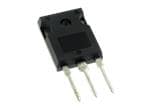

IXFN210N30P3

IXYS
747-IXFN210N30P3
IXFN210N30P3

Mfr.:

Description:
MOSFET Modules N-Channel: Power MOSFET w/Fast Diode

ECAD Model:
Download the free Library Loader to convert this file for your ECAD Tool. Learn more about the ECAD Model.

In Stock: 680

Stock:
680 Can Dispatch Immediately
Factory Lead Time:
26 Weeks Estimated factory production time for quantities greater than shown.
Minimum: 1   Multiples: 1
Unit Price:
$-.--
Ext. Price:
$-.--
Est. Tariff:

Pricing (USD)

Qty. Unit Price
Ext. Price
$45.93 $45.93
$38.80 $388.00

Product Attribute Attribute Value Select Attribute
IXYS
Product Category: MOSFET Modules
RoHS:  
Si
Screw Mount
SOT-227-4
N-Channel
1 Channel
300 V
192 A
14.5 mOhms
- 20 V, + 20 V
- 55 C
+ 150 C
1.5 kW
IXFN210N30
Tube
Brand: IXYS
Configuration: Single
Fall Time: 13 ns
Product Type: MOSFET Modules
Rise Time: 25 ns
Factory Pack Quantity: 10
Subcategory: Discrete and Power Modules
Tradename: HiPerFET
Type: HiperFET
Typical Turn-Off Delay Time: 94 ns
Typical Turn-On Delay Time: 46 ns
Unit Weight: 30 g
Products found:
To show similar products, select at least one checkbox
Select at least one checkbox above to show similar products in this category.
Attributes selected: 0

This functionality requires JavaScript to be enabled.

CNHTS:
8541290000
TARIC:
8541290000
CAHTS:
8541290000
USHTS:
8541290065
JPHTS:
854129000
KRHTS:
8541299000
MXHTS:
8541299900
ECCN:
EAR99

PolarP3™ HiPerFET™ Power MOSFETs

IXYS PolarP3™ HiPerFET™ Power MOSFETs are the latest addition to the benchmark high-performance Polar-Series for the product portfolio between 300V, 500V, and 600V. The high Figure of Merit (FOM), which is the multiplication of Qg and RDS(on), provides an excellent alternative to weaker super junction technologies. These PolarP3 HiPerFETs demonstrate up to a 12% reduction in on-state resistance (Rdson), a 14 percent reduction in gate charge (Qg) and as high as a 20 percent increase in maximum power dissipation (Pd). Lower thermal resistances are also achieved due to reduced chip thicknesses, increasing the total power density of the device.